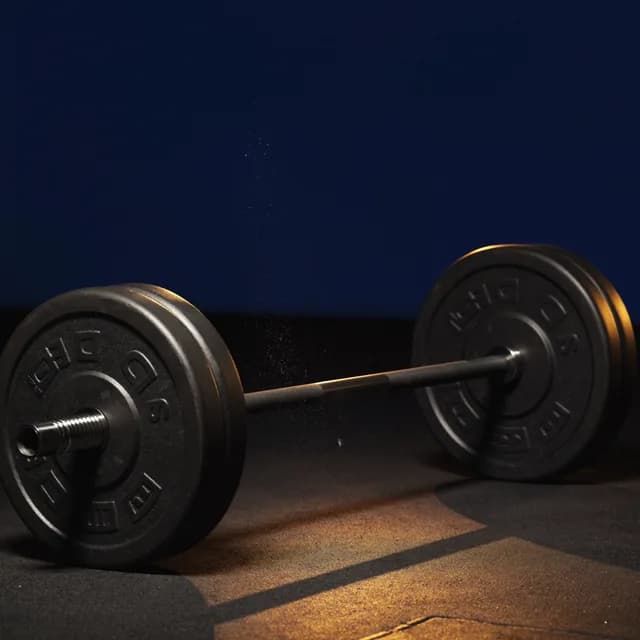
"Heavy squats raise your testosterone." You hear this in every gym and read it in every second training video. It is not wrong, but it is compressed to the point where it regularly turns into a false expectation: a man who believes enough training will fix a genuine deficiency loses months.
What actually happens is well studied, and it is more interesting than the promise.
What happens right after training
Strength training triggers a clear acute hormonal response. Testosterone and growth hormone are elevated for 15 to 30 minutes after the session, provided the stimulus was adequate [1].
How strong the response is depends on how you train. The largest acute elevations come from high volume, moderate to high intensity, short rest intervals, and exercises that load a large muscle mass. Few repetitions at very high load with long rests produce less of it [1].
That is the basis of the squat claim, and it holds. It simply ends after half an hour.
What happens to your resting level
Here it gets uncomfortable. The value your doctor measures fasting in the morning is the resting level, and many studies show no meaningful change in that value during strength training — even though strength and muscle mass increase in those same studies [1].
For muscle growth, the acute response appears to matter more than the resting concentration [1]. Put differently: your muscles grow without your laboratory value rising.
Two things follow, and they belong together:
First: training does not fix a deficiency. A man with confirmed hypogonadism will not train it away. Two morning measurements on different days remain the basis of the diagnosis [5], and six months of disciplined training generally changes nothing about them.
Second: that does not make training worthless. The reverse inference, "if it does not raise the value I do not need it", is the more expensive mistake. Training acts through other routes on precisely the complaints attributed to the deficiency: muscle mass, insulin sensitivity, sleep, mood, body fat. And via body fat it does affect the hormone indirectly, because fat tissue is the main site of conversion into estradiol. What is realistically achievable there is covered in increasing testosterone naturally.
It is not only the hormone, it is the receiver
One point explains why the equation "more hormone equals more muscle" does not add up. For testosterone to do anything in muscle, it needs receptors to bind to, and their number is not fixed. Both the acute hormonal response and the mechanical stimulus of training up- or down-regulate those receptors [1].
That is why two men with identical laboratory values respond differently, and why the mechanical stimulus is not an accessory to the hormone but part of the same chain.
There is also the counterpart. The same training protocols that produce the strongest testosterone response also raise cortisol, which acts catabolically in tissue [1]. Push volume and intensity up without recovery and you shift the balance between the two in the wrong direction. Past a certain point, more training is not more stimulus but more breakdown.
What a high level actually does
How large the gap between training and hormone is was separated cleanly in a 1996 trial. Forty-three healthy men were assigned to four groups: placebo without exercise, testosterone without exercise, placebo plus exercise, and testosterone plus exercise, over ten weeks with weight training three times a week [2].
| Group | Bench press strength gain |
|---|---|
| Placebo, no exercise | −1 kg |
| Testosterone, no exercise | +9 kg |
| Testosterone plus exercise | +22 kg |
The testosterone-plus-exercise group gained 6.1 kilograms of fat-free mass and showed the largest increases in muscle cross-section and strength [2]. The second row is the remarkable one: testosterone with no training produced more strength than placebo with training in the same trial.
And now the part almost always missing when this trial is quoted: the men received 600 milligrams of testosterone enanthate per week. That is a multiple of a replacement dose and sits in the range taken as a cycle in strength sports. The trial therefore does not answer what hormone therapy does in the gym; it answers what anabolic steroids do. Anyone expecting these numbers from replacement therapy will be disappointed.
Where training lowers the value
The most common mistake in this direction is not too little training but too little food alongside a lot of training.
In male endurance athletes, low energy availability goes together with lower testosterone levels, along with lower bone density and a reduced resting metabolic rate [3]. This does not mean starvation in the narrow sense, but the gap between what training consumes and what gets eaten.
In practice this hits more than marathon runners. The man who trains five times a week, diets at the same time, and wonders about fatigue and absent libido belongs in this category too. For him the low value is a consequence, not a cause, and the treatment is eating more and training less, not testosterone.
How are your testosterone levels?
The self-test using the standardized AMS questionnaire shows you in 4 minutes whether an evaluation could be useful — free.
A pointer to this is keeping training and food records for two weeks alongside a blood test. The authors recommend exactly this as simple screening [3].
Training and therapy together
That leaves the practical question: what does doing both achieve? A randomised trial in 83 men aged 65 and over with obesity and persistently low testosterone addressed it. All completed six months of lifestyle therapy with weight management and exercise training; half additionally received testosterone, half placebo [4].
The result is nuanced and rewards careful reading:
- Physical function and strength rose equally in both groups (function 17 against 16 percent, strength 23 against 22 percent).
- At the same 9 percent weight loss, the testosterone group lost less lean mass (−2 against −3 percent) and less thigh muscle volume (−2 against −4 percent).
- Hip bone density was preserved, whereas it declined on placebo (+0.5 against −1.1 percent).
- Aerobic capacity improved more (23 against 16 percent).
- Hematocrit rose more (5 against 1 percent).
The authors summarise it this way: adding testosterone to lifestyle therapy does not further improve overall physical function, but it appears to attenuate the weight-loss-induced reduction in muscle mass and hip bone density [4].
That is an honest and usable answer: you earn the strength gains through the training. What the therapy contributes is protection of muscle and bone, particularly during weight loss. Why hematocrit needs watching alongside is covered in hematocrit and TRT.
How to train if you have a deficiency
Four points that follow from the evidence:
- Large muscle groups, moderate rests, adequate volume. That produces the strongest acute response [1] and is also what builds muscle.
- Two to three strength sessions a week are enough. More is not better once recovery suffers.
- Eat enough, protein in particular. The energy deficit is the underrated hormone suppressor [3].
- Point your expectations at the right target. Your resting value probably will not move with training [1]. What moves is body fat, strength, sleep and symptoms.
If you are unsure whether your complaints fit a deficiency or a training and nutrition error, the online self-test gives a first indication. Making that distinction belongs in a conversation with your values in view, and that is easily arranged by telemedicine.
FAQ
Does strength training raise testosterone permanently?
Usually not. The value is elevated for 15 to 30 minutes after training, but many studies show no meaningful change in the resting level even though strength and muscle mass increase [1]. For muscle growth the acute response evidently matters more than the resting concentration.
Can I train away a testosterone deficiency?
No. A confirmed deficiency persists, and the diagnosis rests on two morning measurements on different days [5]. Training does improve much of what you attribute to the deficiency, however, and through weight loss it also affects the hormonal picture indirectly.
Why are my values low even though I train a lot?
Often because of an energy deficit. In male endurance athletes, low energy availability goes with lower testosterone, lower bone density and a reduced resting metabolic rate [3]. Heavy training plus dieting is the typical constellation. Here eating more helps, not testosterone.
Does therapy build more muscle in the gym?
With a deficiency it mainly protects muscle mass and bone density, especially during weight loss; strength and function rose equally with and without testosterone in a randomised trial [4]. The spectacular gains from the 1996 trial rest on 600 milligrams per week [2], a multiple of a replacement dose.
Which training produces the strongest hormonal response?
High volume, moderate to high intensity, short rests, and exercises loading a large muscle mass such as squats or deadlifts [1]. Few repetitions at maximal load with long rests produce less. For training success, though, this is only one factor among several.
Further Reading

Specialist in General Internal Medicine · treating physician
This article was medically reviewed by Dr. Ramadan for accuracy. It is based on current research and international guidelines.
Your Next Step
You've informed yourself — now you can find out in 4 minutes whether a medical evaluation makes sense for you.
Sources
- [1]Kraemer WJ et al. "Hormonal responses and adaptations to resistance exercise and training." Sports Med. 2005;35(4):339-361. PubMed
- [2]Bhasin S et al. "The effects of supraphysiologic doses of testosterone on muscle size and strength in normal men." N Engl J Med. 1996;335(1):1-7. PubMed
- [3]Cupka M et al. "Hungry runners - low energy availability in male endurance athletes and its impact on performance and testosterone: mini-review." Eur J Transl Myol. 2023;33(2):11104. PubMed