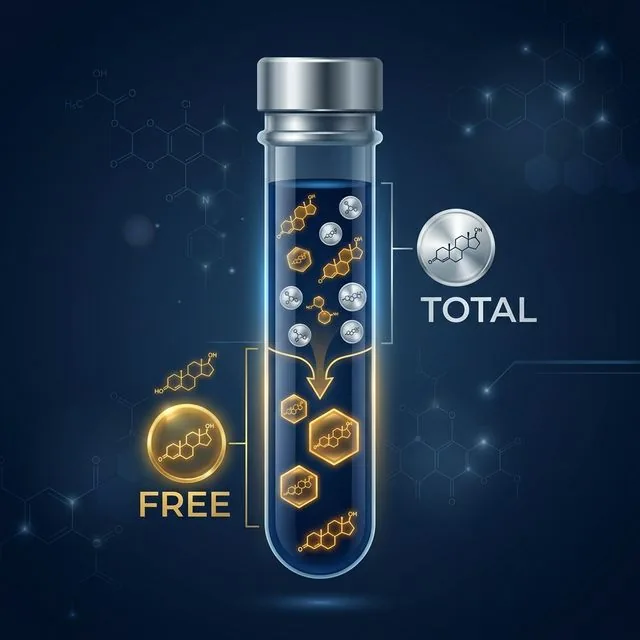
You had a blood test done, your total testosterone is within the normal range — yet you feel tired, unmotivated, and your libido has noticeably declined. How is that possible? The answer often lies in the difference between total testosterone and free testosterone — two laboratory values that are related but provide entirely different information.
This guide explains the difference between the two measurements, why free testosterone is often more clinically relevant, and how you and your physician can choose the right value for assessing your hormonal status.
Total Testosterone: What It Measures
Total testosterone is the standard value determined in most blood tests. It encompasses the entire amount of testosterone in the blood — regardless of whether it is biologically active or not. In the blood, testosterone exists in three forms:
SHBG-bound testosterone (60–70%): The largest proportion is firmly bound to sex hormone-binding globulin (SHBG). This testosterone is biologically inactive — it cannot enter cells and cannot exert any effect. It circulates as a reserve in the blood.
Albumin-bound testosterone (25–35%): A further proportion is loosely bound to albumin. This binding is weak and can be easily released, which is why this testosterone is considered "bioavailable" — it is available to the body when needed.
Free testosterone (1–3%): Only a small fraction circulates freely and unbound in the blood. This free testosterone is immediately biologically active — it can directly enter target cells and exert its effects.
The total testosterone value adds all three forms together. The Endocrine Society sets the normal range for adult men at 10.4–34.7 nmol/L (Bhasin et al., 2018).
Free Testosterone: The Biologically Active Fraction
Free testosterone comprises only 1–3% of total testosterone but is the clinically decisive value. It is the fraction that can actually bind to androgen receptors and exert effects — in muscles, brain, bones, and sexual organs.
Why is this distinction so important? Because total testosterone can be normal while free testosterone is low. The most common reason: elevated SHBG levels. When SHBG rises, it binds more testosterone — and less is available to the body as free, active testosterone. Total testosterone looks normal on the lab report, but the patient effectively has too little functional testosterone.
When Is Free Testosterone More Important Than Total Testosterone?
The European Male Ageing Study (EMAS) demonstrated that free testosterone is a more reliable marker for symptomatic hypogonadism than total testosterone in certain situations (Wu et al., 2010). Free testosterone is particularly relevant in men over 50 (SHBG naturally rises with age), in overweight individuals (obesity alters SHBG levels), in liver disease (the liver produces SHBG), in hyperthyroidism (raises SHBG), and when taking certain medications (e.g. anticonvulsants).
Case Example: Normal Total Testosterone, Low Free Testosterone
A 45-year-old man presents with symptoms of testosterone deficiency: fatigue, loss of libido, difficulty concentrating. His total testosterone is 15 nmol/L — formally within the normal range. However, his SHBG is elevated (65 nmol/L instead of the usual 20–50 nmol/L). His calculated free testosterone is only 180 pmol/L — clearly below the threshold of 220 pmol/L that EMAS defined for symptomatic hypogonadism. Without determining free testosterone, this man would have been discharged as "hormonally unremarkable" — despite clinically relevant deficiency.
How Is Free Testosterone Measured?
There are two methods for determining free testosterone:
Calculation (Standard)
The most common method is calculating free testosterone from total testosterone and SHBG — known as the Vermeulen formula. This calculation is sufficiently accurate for clinical practice and is recommended by the Endocrine Society (Bhasin et al., 2018). For this, both total testosterone and SHBG are measured at the blood draw. Our article on blood work for TRT provides the complete recommended panel.
Direct Measurement (Equilibrium Dialysis)
Equilibrium dialysis is the gold standard for directly measuring free testosterone. It is more accurate than calculation but also considerably more complex and expensive, and is therefore only offered by specialised laboratories. For routine diagnostics, the calculated method is sufficient; direct measurement is used for unclear findings.
Important: Many laboratories offer a "free testosterone" test via analogue assay. This method is unreliable and is explicitly not recommended by the Endocrine Society. Ensure that your free testosterone is either calculated (Vermeulen formula) or determined by equilibrium dialysis.
Reference Ranges: What Is Normal?
Normal values vary by laboratory and method. The following reference values are based on current guidelines:
| Age | Total Testosterone (nmol/L) | Free Testosterone (pmol/L) |
|---|---|---|
| 20–30 | 12–35 | 250–700 |
| 30–40 | 10–30 | 220–550 |
| 40–50 | 10–28 | 180–500 |
How are your testosterone levels?
Our doctor-developed self-test shows you in 4 minutes whether an evaluation could be useful — free and anonymous.
| 50–60 | 9–25 | 150–450 | | 60–70 | 8–22 | 120–400 |
EMAS defined the threshold for symptomatic hypogonadism at total testosterone below 11 nmol/L or free testosterone below 220 pmol/L (Wu et al., 2010). Detailed reference tables are available in our guide on testosterone reference ranges.
The Role of SHBG
SHBG is the key player in the relationship between total and free testosterone. Numerous factors influence SHBG levels:
SHBG-increasing (less free testosterone): Age, hyperthyroidism, liver disease (hepatitis, cirrhosis), certain medications (anticonvulsants, oestrogens), genetic predisposition.
SHBG-decreasing (more free testosterone): Overweight (obesity), insulin resistance/type 2 diabetes, hypothyroidism, anabolic steroid use, growth hormone treatment.
Understanding these relationships is relevant because an isolated total testosterone value without SHBG determination provides an incomplete picture. This is why guidelines recommend the simultaneous determination of total testosterone and SHBG for any suspicion of hypogonadism (Jayasena et al., 2022).
What Does This Mean for TRT Diagnostics?
For diagnosis and treatment planning, the distinction has practical consequences:
Diagnostics: When total testosterone is borderline (e.g. 11–14 nmol/L) and symptoms are present, calculated free testosterone can be the deciding factor. If it is below 220 pmol/L, this supports a diagnosis of treatable hypogonadism — even if total testosterone is formally still within the normal range.
Therapy monitoring: During TRT, both total and free testosterone are monitored to find the optimal dose. The goal is free testosterone in the mid-normal range — not maximally high.
Individual advice: During a telemedicine consultation, your physician considers both values when assessing your hormonal status and explains which value is more relevant in your individual situation.
Practical Relevance for Patients
For you as a patient, this means: request that SHBG is always determined alongside total testosterone in any testosterone assessment. Only then can your physician calculate free testosterone and correctly evaluate your hormonal status. At Swiss TRT, determining both values is standard — our panel always includes total testosterone, SHBG, and calculated free testosterone, supplemented by LH, FSH, and other relevant markers. This gives you and your physician the best possible foundation for an informed decision. If you are unsure whether your symptoms indicate testosterone deficiency, our free online self-test provides an initial indication — quick, discreet, and non-binding.
FAQ
Why do some doctors only test total testosterone?
In routine diagnostics, many GPs initially test only total testosterone because it is the simplest and most widely available test. For a clearly low value (below 8–10 nmol/L), this is also sufficient — the diagnosis is clear. It becomes problematic with borderline values (10–14 nmol/L), where total testosterone alone is insufficient to reliably confirm or exclude clinically relevant deficiency. In these cases, SHBG should always be measured alongside and free testosterone calculated. In a specialised assessment — for example through Swiss TRT — both values are determined as standard.
Can I calculate my free testosterone myself?
In principle, yes, using the Vermeulen formula. You need three values: total testosterone, SHBG, and albumin. Online calculators are available that automate the calculation. However, we recommend always discussing the interpretation with a physician — individual laboratory values without clinical context can easily be misinterpreted. Our online self-test offers a low-threshold entry point.
Can I naturally increase my free testosterone?
Yes, indirectly. Since SHBG has the greatest influence on free testosterone, measures that influence SHBG levels can alter free testosterone. Weight loss in overweight individuals moderately lowers SHBG and thereby increases free testosterone. Resistance training stimulates testosterone production and improves body composition. Adequate sleep supports hormone production. Stress reduction lowers cortisol, which indirectly influences SHBG. More on this in our article about increasing testosterone naturally.
Which value is used for TRT diagnosis?
Current guidelines recommend a stepped diagnostic approach: total testosterone is determined first. If it is below 8 nmol/L, the diagnosis is clear with matching symptoms. If it falls in the grey area (8–12 nmol/L), SHBG should be determined and free testosterone calculated. Free testosterone below 220 pmol/L in combination with at least three key symptoms defines treatable hypogonadism. At Swiss TRT, the complete panel is routinely determined — for maximally accurate diagnosis.
Further Reading

Specialist in General Internal Medicine · treating physician
This article was medically reviewed by Dr. Ramadan for accuracy. It is based on current research and international guidelines.
Your Next Step
You've informed yourself — now you can find out in 4 minutes whether a medical evaluation makes sense for you.
Sources
- [1]Bhasin S et al. "Testosterone therapy in men with hypogonadism: an Endocrine Society clinical practice guideline." J Clin Endocrinol Metab. 2018;103(5):1715-1744. PubMed
- [2]Wu FC et al. "Identification of Late-Onset Hypogonadism in Middle-Aged and Elderly Men." N Engl J Med. 2010;363(2):123-135. PubMed
- [3]Jayasena CN et al. "Society for Endocrinology guidelines for testosterone replacement therapy in male hypogonadism." Clin Endocrinol (Oxf). 2022;96(2):200-219. PubMed