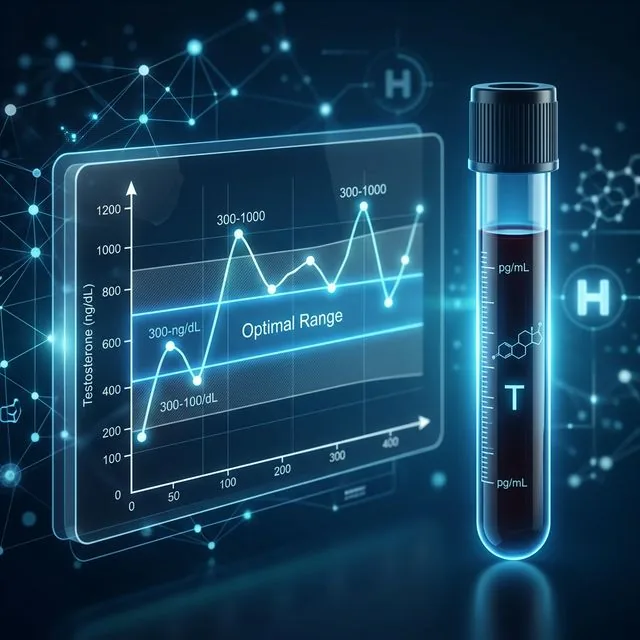
"How high should my testosterone levels actually be?" This is a question many men ask themselves when they receive their lab results. The reference ranges shown on lab reports are often very wide and difficult to interpret. Worse, different laboratories may use different reference populations, assays, and units — leading to confusion and misdiagnosis.
In this article, we dissect the lab values. We provide a clear table showing what is considered "normal," at what point a medical deficiency exists, and what the precise target values are during Testosterone Replacement Therapy (TRT).
Testosterone Reference Ranges: The Overview Table
The following table is based on current European guidelines (the European Association of Urology, 2024 edition) and on the Endocrine Society guideline of 2018, which is still the reference document. It displays the reference ranges for total testosterone in blood serum [1][2].
Depending on the laboratory, values are reported in different units — mostly in nmol/L (nanomoles per liter) or ng/mL (nanograms per milliliter) / ng/dL.
| Classification | nmol/L | ng/mL | ng/dL |
|---|---|---|---|
| Definite Deficiency | < 8 | < 2.3 | < 230 |
| Gray Zone (requires further review) | 8–12 | 2.3–3.5 | 230–350 |
| Normal Range (healthy male) | 12–35 | 3.5–10.0 | 350–1000 |
| Upper Normal Range | > 35 | > 10.0 | > 1000 |
What do these numbers actually mean?
- Below 8 nmol/L (< 2.3 ng/mL): A deficiency requiring treatment is almost always present (provided clinical symptoms exist). The body is no longer producing enough testosterone to maintain normal functions such as muscle maintenance, bone density, red blood cell production, and sexual health.
- 8 to 12 nmol/L (2.3–3.5 ng/mL): This is the so-called "gray zone." Some men in this range experience no complaints whatsoever, while others already suffer from severe symptoms. In this range, free testosterone must absolutely be determined — and the clinical picture becomes decisive.
- Above 12 nmol/L (> 3.5 ng/mL): A classic testosterone deficiency is highly unlikely at these values, and TRT is generally not indicated according to medical guidelines. However, symptoms combined with very low free testosterone can occasionally justify treatment even with total T in this range.
Important: A single blood value is never enough for a diagnosis. Levels fluctuate throughout the day (highest in the morning) and can drop temporarily due to stress, lack of sleep, or illness. A serious diagnosis always requires at least two morning blood draws taken fasting before 11 a.m. [1]
Converting units: ng/dL, nmol/L and pg/mL
Testosterone has a molar mass of 288.4 g/mol. Everything follows from that:
- 1 nmol/L = 28.8 ng/dL = 2.88 ng/mL
- 1 pmol/L = 0.288 pg/mL (free testosterone)
| Reference point | ng/dL | ng/mL | nmol/L |
|---|---|---|---|
| Definite deficiency | 230 | 2.3 | 8.0 |
| Endocrine Society threshold | 264 | 2.64 | 9.2 |
| EAU lower limit | 346 | 3.46 | 12.0 |
| Median, healthy young men | 531 | 5.31 | 18.4 |
Part of the gap between two lab reports comes from the assay, not from your body [4].
Total Testosterone: What the Blood Value Actually Measures
Total testosterone is everything in your serum added up: bound to SHBG, bound to albumin, and the free fraction. Every guideline threshold refers to this number, and the diagnosis is made on it, not on free testosterone [1][2].
Watch the method: mass spectrometry is the reference, most routine laboratories run immunoassays, and a change of laboratory alone can move your result by several nmol/L. Across decades: Testosterone after 30.
Guideline Comparison: Endocrine Society vs. EAU
Two major guidelines define the diagnostic criteria, and it's important to understand where they agree and differ:
| Criterion | Endocrine Society (2018) | EAU (2024) |
|---|---|---|
| Deficiency threshold | < 264 ng/dL (9.2 nmol/L) | < 12 nmol/L (346 ng/dL) |
| Minimum blood draws | 2 morning samples | 2 morning samples |
| Free T recommended | In borderline cases | Always alongside total T |
| Symptoms required | Yes | Yes |
| SHBG assessment | When total T borderline | Routinely recommended |
In practice, both guidelines agree on the fundamentals: testosterone deficiency requires both low laboratory values and clinical symptoms. There is no treatment based on numbers alone.
264 ng/dL is the 2.5th percentile of healthy men aged 19 to 39 in the harmonized cohort analysis [4], adopted by the Endocrine Society in 2018 [1]. Older texts quote 300 ng/dL, the superseded 2010 figure.
What this means for you: between 9 and 12 nmol/L the verdict depends on the guideline your doctor follows, and free testosterone decides. Swiss physicians mostly follow the EAU limit of 12 nmol/L [2].
Free Testosterone vs. Total Testosterone
Total testosterone is only half the story. The vast majority of testosterone in the blood is bound to carrier proteins — especially SHBG (Sex Hormone-Binding Globulin) — and is not directly available for the body's tissues.
What matters for your well-being is free testosterone (often summarized alongside albumin-bound T as "bioavailable testosterone").
If your SHBG level is very high (which frequently occurs with age, obesity, or liver disease), you could have a perfectly normal total testosterone of 15 nmol/L but still suffer from symptoms of deficiency because hardly any free testosterone is available for your cells. That is why a comprehensive hormone panel always includes total testosterone, SHBG, and the calculation of free testosterone.
The clinical significance of SHBG
SHBG is often overlooked, but it plays a crucial role in testosterone diagnostics:
- Elevated SHBG (common in older age, hyperthyroidism, liver disease, low BMI): Total testosterone appears normal, but free T may be critically low. These patients often respond well to TRT despite seemingly adequate total testosterone levels.
- Low SHBG (common in obesity, type 2 diabetes, metabolic syndrome): Total testosterone appears low, but free T may be sufficient. In these cases, weight management and metabolic optimization may resolve symptoms before TRT is considered [3].
- Calculation method: Free testosterone is typically calculated using the Vermeulen formula, which requires total testosterone, SHBG, and albumin values. Direct free testosterone assays exist but are less reliable at many laboratories.
Free Testosterone: Normal Values and Reference Range in pg/mL
The Endocrine Society asks for free testosterone when total testosterone is borderline, and in obesity, diabetes, liver or thyroid disease [1].
In healthy, non-obese men aged 18 to 39, directly measured free testosterone runs from 184 to 749 pmol/L [5], roughly 53 to 216 pg/mL, by dialysis in 1,202 men.
Swiss laboratories practically never measure it. Your report shows a calculated free testosterone, from total testosterone, SHBG and albumin, with its own range: 230 to 630 pmol/L, or 66 to 182 pg/mL [6].
| Free testosterone | pmol/L | pg/mL | Origin |
|---|---|---|---|
| Measured (dialysis), age 18–39 | 184–749 | 53–216 | percentiles, n = 1,202 [5] |
| Calculated, young men | 230–630 | 66–182 | ± 1.96 SD, n = 67 [6] |
How are your testosterone levels?
Our doctor-developed self-test shows you in 4 minutes whether an evaluation could be useful — free and anonymous.
| Deficiency threshold (calculated) | < 225 | < 65 | EAU [2] |
The two upper rows are not interchangeable, so check which method your laboratory states; direct immunoassays are unreliable [3]. More: Free vs. total testosterone.
Measured free testosterone falls by about 4.5 pmol/L per year, and a BMI of 30 costs another 14.4 percent [5]. Limits: 1,202 White men; 67 young Britons for the calculated range.
TRT Target Values: Where should the levels be?
If a testosterone deficiency has been diagnosed and you decide to undergo Testosterone Replacement Therapy (TRT), the question arises regarding the goal of treatment.
The primary objective of TRT is not to hit a specific number on paper. The goal is always the complete resolution of deficiency symptoms while simultaneously avoiding adverse effects (such as an excessive increase in red blood cells).
Medical guidelines and clinical best practices define the following TRT targets:
- The Therapeutic Window: TRT should consistently elevate serum testosterone into the middle-to-upper third of the physiological normal range over the long term.
- Target Value as a Number: Often, the targeted trough level (the lowest point right before the next application) is between 15 and 25 nmol/L (approx. 4.5–7.2 ng/mL).
- Avoiding Peaks: Extreme highs and lows, which were common with older injection protocols administered every 3–4 weeks, are avoided today through more modern approaches (like daily creams or frequent micro-injections) to prevent mood swings.
- Symptom Control: If a patient is symptom-free at 16 nmol/L, has excellent lipids, and a good hematocrit, there is no medical reason to increase the dose just to artificially force a level of 25 nmol/L.
Age-related decline: What's normal?
Testosterone levels naturally decline with age. Older cohort work such as the Framingham Heart Study puts the average decrease at roughly 1–2% per year after age 30; newer data are flatter, so treat that as an upper bound. What stays true is that a 60-year-old man will naturally have lower levels than a 25-year-old, and that age alone does not constitute a reason for therapy. The key question is always whether symptoms are present and whether levels fall below the diagnostic threshold.
Testosterone Levels by Age: Averages Per Decade
How steeply testosterone falls is disputed. Among 27,687 Korean men aged 40 and over the decline came to 0.021 ng/mL per year of life, about 0.4 percent annually [8].
Orientation values as they appear on laboratory reports, not from one study, and no replacement for the harmonized reference ranges [4]:
| Age group | Average (ng/dL) | Range (nmol/L) |
|---|---|---|
| 20–29 years | 388–558 | 13.5–19.4 |
| 30–39 years | 352–502 | 12.2–17.4 |
| 40–49 years | 330–450 | 11.5–15.6 |
| 50–59 years | 300–410 | 10.4–14.2 |
| 60+ years | 260–380 | 9.0–13.2 |
Some 60-year-olds sit at 18 nmol/L, some 30-year-olds at 10 nmol/L. Value and symptoms decide together, never the decade alone.
The average testosterone level in men as a number
The mean in men aged 40 and above is 4.8 ± 1.8 ng/mL, about 480 ng/dL or 16.6 nmol/L [8]. Healthy men aged 19 to 39 sit higher, with a median of 531 ng/dL and 264 ng/dL as the 2.5th percentile [4].
Biochemical hypogonadism, there defined as below 2.5 ng/mL, rose from 5.5 percent among men in their forties to 11.6 percent from age 70 [8]. Higher BMI, fasting glucose and triglycerides went with lower testosterone. Korean screening data by immunoassay, so read it as an order of magnitude.
Why free testosterone falls with age while total testosterone barely moves
In 7,812 UK Biobank men aged 40 to 69, total testosterone barely moved over 4.3 years (+0.06 nmol/L), while SHBG rose by 3.69 nmol/L and calculated free testosterone dropped by 10.7 pmol/L [7]. Production does not collapse first; more of the hormone gets bound.
That is why SHBG belongs in the panel of every symptomatic man over 50. Limits: immunoassay, 4.3 years, ages 40 to 69.
Testosterone Blood Values: Which Numbers Belong Together
A single testosterone blood value says little. These blood values become meaningful as a set, so a serious workup orders a package [1][2]:
| Blood value | Tells you | Flag when |
|---|---|---|
| Total testosterone | diagnostic threshold | < 12 nmol/L |
| SHBG | explains a low free T | rises with age |
| Free testosterone | the hormone that acts | < 225 pmol/L |
| LH, FSH | testes or pituitary | high LH: testes |
| Estradiol, hematocrit | safety during TRT | hematocrit > 54% |
What gets rechecked and how often: TRT blood work and 10 blood values every man over 30 should know.
Conclusion: Symptoms trump paper values
A table of reference ranges provides excellent initial guidance. However, it does not replace a detailed specialist diagnosis. In endocrinology, the principle remains: We treat the patient, not the lab results.
If your values are in the gray zone (8–12 nmol/L) and you suffer from typical symptoms like exhaustion, loss of libido, or depressive moods, you should consult a doctor specializing in hormone therapies. An expert will evaluate not just the total testosterone, but the entire interplay of free testosterone, LH, FSH, estradiol, and SHBG.
Whether your symptoms match your numbers is what the self-test is for, the step before a medical assessment.
FAQ
What is a normal testosterone level for a 40-year-old man? According to current guidelines, the normal range for total testosterone is 12–35 nmol/L (350–1000 ng/dL), regardless of age. However, levels naturally decline by about 1–2% per year after age 30. A 40-year-old man with a level of 14 nmol/L is technically "normal," but if he has significant symptoms, further evaluation including free testosterone is warranted.
Can stress temporarily lower my testosterone levels? Yes. Acute and chronic stress elevates cortisol, which suppresses the hypothalamic–pituitary–gonadal axis and can significantly reduce testosterone production. This is why diagnostic guidelines require at least two blood draws on separate days, taken in the morning when fasting, to rule out temporary fluctuations.
Why does my lab report show a different reference range than this article? Laboratories use different assays, calibration standards, and reference populations to establish their ranges. The values in this article are based on internationally harmonized guidelines (Endocrine Society, EAU). If your lab uses a non-standardized assay, the numbers may differ. Always discuss your results with a specialist who can interpret them in context.
At what testosterone level should I consider TRT? Guideline-based TRT is typically recommended when total testosterone is consistently below 8–12 nmol/L (230–350 ng/dL) AND clinical symptoms are present. A single low reading is not sufficient. Free testosterone should also be evaluated, especially if total testosterone is in the gray zone. For a complete guide to when therapy makes sense, see our detailed article on testosterone levels and therapy thresholds.
How high is free testosterone normally in pg/mL? Directly measured, the range for healthy men aged 18 to 39 is 53 to 216 pg/mL [5]; for the calculated value Swiss laboratories report, 66 to 182 pg/mL [6]. Different methods, so check which one your report states.
Further Reading

Specialist in General Internal Medicine · treating physician
This article was medically reviewed by Dr. Ramadan for accuracy. It is based on current research and international guidelines.
Your Next Step
You've informed yourself — now you can find out in 4 minutes whether a medical evaluation makes sense for you.
Sources
- [1]Bhasin S et al. "Testosterone Therapy in Men With Hypogonadism: An Endocrine Society Clinical Practice Guideline." J Clin Endocrinol Metab. 2018;103(5):1715-1744. PubMed
- [2]European Association of Urology (2024). EAU Guidelines on Sexual and Reproductive Health — Male Hypogonadism. Source
- [3]Vermeulen A et al. "A critical evaluation of simple methods for the estimation of free testosterone in serum." J Clin Endocrinol Metab. 1999;84(10):3666-72. PubMed