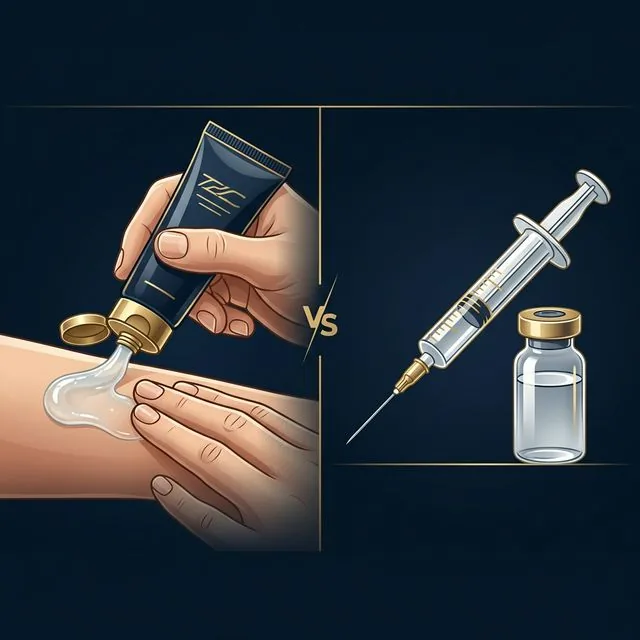
When deciding on testosterone replacement therapy (TRT), a practical question arises: gel or injection? Both delivery methods are approved by Swissmedic and both achieve therapeutic testosterone levels. Yet they differ substantially in handling, pharmacokinetics, everyday practicality, and personal comfort. This guide compares the two main options on an evidence basis and helps you make the right choice together with your physician.
Men ask it plainly: gel or the shot? So does this guide.
Testosterone Gel: Daily Application, Stable Levels
Testosterone gel (e.g. Testogel®, Androgel®) is applied once daily to the skin — typically on the upper arms, shoulders, or abdomen. The testosterone is absorbed through the skin and enters the bloodstream directly.
Advantages of Gel
Physiologically stable levels: The gel mimics the natural circadian rhythm. The TRAVERSE study, the largest randomised TRT trial with over 5,000 participants, used 1.62% testosterone gel and confirmed both efficacy and cardiovascular safety over a period of up to four years (Lincoff et al., 2023). Testosterone levels remain relatively constant throughout the day — without the peaks and troughs that can occur with injections [1].
Documented effect on libido: In the TRAVERSE sexual-function substudy, 1,161 men on gel gained more sexual activity and libido than on placebo; erectile function did not [5].
Pain-free application: No needle, no injection pain. For men with needle anxiety or those who prefer a non-invasive option, the gel is the more comfortable choice.
Flexible dose adjustment: The dose can be adjusted in small increments — an advantage over injections, where dosing occurs in larger steps. If side effects appear, the dose can be reduced more quickly.
Rapid reversibility: When the gel is discontinued, exogenous testosterone levels normalise within a few days. This can be relevant if side effects occur or therapy needs to be interrupted.
Disadvantages of Gel
Daily routine: The gel must be applied at the same time every day. Missed applications lead to level drops. For men who prefer a "set-and-forget" solution, this can be inconvenient.
Transfer risk: Until the gel has fully absorbed (approximately 2–5 hours), there is a risk of transferring testosterone to those in close contact — particularly female partners and children. Skin contact should be avoided during this time or covered clothing worn. The Endocrine Society recommends covering the application site after drying (Bhasin et al., 2018) [2]. How much transfers, and what stops it, is measured below.
Absorption varies: Skin permeability differs between individuals and can be influenced by sweating, bathing, or skincare products. Some men do not achieve desired levels despite correct application.
Testogel in Everyday Use: Application Site and Transfer
Apply it to the upper arms, shoulders, or abdomen — the only sites the approved preparations were tested on. Genital skin absorbs far more, the delivered dose stops being predictable, and nothing is licensed for it.
Transfer is well measured. In a randomised crossover trial, 24 couples spent 15 minutes in skin contact two hours after applying 1.62% gel. The women's exposure rose by up to 27% with 2.5 g and 280% with 5.0 g, though mean levels stayed in the normal female range and were back at baseline within 48 hours [8]. What lowers it:
| Measure | Result |
|---|---|
| Upper arm/shoulder, uncovered | Highest transfer |
| Abdomen, uncovered | Lower |
| T-shirt over the site (abdomen, 2.5 g) | Prevented completely |
| Site washed beforehand | Mean at baseline, peak +14% |
Clothing over the site is the most effective single measure, washing the second. Read the figures as an upper bound — 24 couples, open-label, contact exaggerated by design.
Testosterone Injections: Less Frequent, Stronger Effect
Injections deliver testosterone directly into the muscle (intramuscular) or under the skin (subcutaneous). In Switzerland, two main variants are available: testosterone enanthate (e.g. Testoviron®), administered every 1–2 weeks, and testosterone undecanoate (Nebido®), administered only every 10–14 weeks.
Advantages of Injection
Infrequent application: Depending on the preparation, only every 1–2 weeks (enanthate) or every 10–14 weeks (undecanoate). This means less daily effort and no daily routine.
No transfer risk: Unlike the gel, there is no risk of transfer to partners or children — an important advantage for families with small children.
Reliable absorption: Drug uptake with injections is more predictable than with topical application. Individual skin characteristics play no role.
Cost advantage: Testosterone enanthate injections are generally cheaper than gel preparations. Since most patients pay for TRT medication themselves — basic insurance covers it only in exceptional cases — this price difference is directly relevant; it matters less if your supplementary insurance contributes. Details on costs are available in our article about TRT costs in Switzerland.
Disadvantages of Injection
Hormonal fluctuations: With short-acting injections (enanthate), a peak occurs shortly after injection followed by a gradual decline until the next dose. Some men notice a decrease in energy and mood in the days before the next injection. Long-acting undecanoate (Nebido) substantially reduces these fluctuations.
Injection pain: Intramuscular injections can be uncomfortable, particularly with Nebido (4 ml oil volume). Subcutaneous injections with smaller needles are an increasingly popular alternative with comparable efficacy (Al-Futaisi et al., 2006) [4].
Doctor visits or self-injection: Nebido is typically administered by a physician, while enanthate can be self-injected after instruction. Self-injection requires correct technique and hygiene.
The Testosterone Shot: Pros and Cons at a Glance
The pros and cons of the testosterone shot, as a list:
Pros
- You rarely think about it: every one to two weeks with enanthate, every 10 to 14 with undecanoate.
- Reliable uptake. Of 150 men on weekly subcutaneous enanthate, 92.7% hit the 300 to 1,100 ng/dl target at week 12 [7].
- No transfer to a partner or children.
- Cheaper than gel, which counts when you pay yourself.
- Peaks stay controlled: 91.3% below 1,500 ng/dl, nobody above 1,800 [7].
Cons
- You have to use a needle. In the data the smallest hurdle: over 95% reported no injection pain [7] — though with an auto-injector, not Nebido.
- Coarser dose steps, set by volume and interval, not daily increments.
- Swings between doses. On enanthate, drive can dip before the next shot.
- Nothing can be taken back. A depot cannot be washed off.
- Discontinuations are not rare — number below.
Your physician walks you through self-injection in a telemedicine consultation.
Side Effects of the Testosterone Shot: What the Numbers Show
Both forms share one main side effect: testosterone drives red blood cell production, haematocrit rises, thick blood raises thrombosis risk. Whether the shot does this more than gel was tested in a Bayesian network meta-analysis of 29 placebo-controlled trials, 3,393 men:
How are your testosterone levels?
Our doctor-developed self-test shows you in 4 minutes whether an evaluation could be useful — free and anonymous.
| Form | Rise in haematocrit (95% CI) |
|---|---|
| Patch | +1.4% (0.2–2.6) |
| Intramuscular undecanoate | +1.6% (0.3–3.0) |
| Gel | +3.0% (1.8–4.3) |
| Intramuscular enanthate/cypionate | +4.0% (2.9–5.1) |
| Oral undecanoate | +4.3% (0.7–8.0) |
The ranking suggests a disadvantage for the short-acting shot but does not prove one. Only intramuscular cypionate/enanthate rose significantly more than the patch; between gel and enanthate no reliable difference appeared, and the authors call the clinical significance questionable [6]. There are no head-to-head trials, and the endpoint is a laboratory value.
Discontinuations are more concrete. Over 52 weeks, rises in haematocrit, blood pressure and PSA led 30 of 150 men — one in five — to stop, with no serious drug-related events [7]. Single-arm and manufacturer-funded, so read it as an order of magnitude.
Either way: haematocrit, blood pressure and PSA get measured on a schedule. If haematocrit climbs, the dose drops, doses are split smaller, or blood is donated — see blood work for TRT and TRT side effects.
Direct Comparison: Gel vs. Injection
| Criterion | Gel | Injection (Enanthate) | Injection (Undecanoate) |
|---|---|---|---|
| Application | Daily | Every 1–2 weeks | Every 10–14 weeks |
| Level stability | Very stable | Fluctuations possible | Stable |
| Pain-free | ✅ | ❌ | ❌ |
| Transfer risk | ⚠️ Yes | ✅ No | ✅ No |
| Dose flexibility | High | Medium | Low |
| Cost/month | ~CHF 80–120 | ~CHF 30–60 | ~CHF 40–80 |
| Self-administration | ✅ | ✅ (after training) | ❌ (physician) |
| TRAVERSE evidence | ✅ (study form) | Comparable | Comparable |
The "level stability" row is not a hunch: weekly subcutaneous enanthate kept 91.3% of men below 1,500 ng/dl [7], while large single doses of the same substance showed the steepest haematocrit rise of all [6]. Swings come from the size of the single dose, not from the needle.
Gel or Shot: Which One Fits When?
The table lists criteria but does not weigh them. These rules do:
Gel, if you dislike needles, want a cautious start, run a high haematocrit, or need a therapy you can stop within days.
The shot, if you have small children, will forget a daily ritual, watch the cost, or missed target levels on gel.
Undecanoate (Nebido), once your dose is stable. For initial titration a three-month depot is the wrong tool.
Either, if none applies — then preference decides, as the guidelines intend. Unsure whether TRT is your question? Start with the self-test.
What Do Guidelines Recommend?
The Endocrine Society (2018) and the Society for Endocrinology (2022) express no clear preference for a specific delivery form. Both recommend making the choice individually based on patient preference, lifestyle, cost, and clinical response (Bhasin et al., 2018; Jayasena et al., 2022) [2] [3].
In practice, many physicians begin with the gel. At Swiss TRT it is likewise the usual starting point, because it enables the safest initial titration: the dose can be quickly adjusted, levels remain stable, and if side effects occur, therapy can be immediately interrupted. If the gel fails to achieve the desired level or the patient prefers less frequent application, a switch to injections is made.
During a telemedicine consultation, your physician can advise you individually on which form best suits your situation. The entire process — from blood draw through diagnosis to prescription — can be conveniently managed online.
Can You Switch Between Delivery Forms?
Yes, switching is possible at any time and common in practice. Typical reasons for switching from gel to injection include inadequate absorption despite correct application, the desire for less daily effort, or concerns about transfer risk. Conversely, some men switch from injection to gel if they find the level fluctuations between injections bothersome or develop a fear of needles.
Your treating physician will recalculate the dosage when switching and request a follow-up blood test after 4–6 weeks to ensure the target level is achieved. Detailed information about relevant laboratory values is available in our article on blood work for TRT.
Practical Tips for Daily Life
Regardless of the chosen delivery form, there are practical aspects that make daily therapy easier. Gel users should apply the preparation at the same time each day — ideally in the morning after showering, as the skin is then clean and dry. Avoid skin contact with your partner or children for at least 2 hours after application, and wash your hands thoroughly. For injections, a fixed schedule is recommended: enter injection dates in your calendar and rotate the injection site (thigh, gluteal muscle) to minimise tissue irritation. Both forms require regular blood checks — at Swiss TRT, this is ensured through a structured monitoring programme. Store your medication at room temperature and check the expiry date regularly. When travelling abroad, we recommend carrying a medical certificate confirming the medical necessity of carrying testosterone preparations.
FAQ
Is gel or injection more effective?
Both delivery forms are equally effective when the correct dose is chosen. The Endocrine Society and the Society for Endocrinology confirm that both gel and injections achieve therapeutic testosterone levels and equally improve hypogonadism symptoms. The difference lies not in efficacy but in pharmacokinetics, handling, and personal comfort. The TRAVERSE study — the largest TRT safety trial ever — was conducted with testosterone gel and confirmed significant improvement in sexual function, vitality, and quality of life.
Which delivery form has fewer side effects?
The side effects of TRT (polycythaemia, acne, mood changes) are dose-dependent and occur with both forms. The advantage of gel is that the dose can be adjusted more quickly and precisely when side effects arise. With injections — particularly short-acting ones — level fluctuations can lead to more pronounced mood swings in some men. Long-acting undecanoate (Nebido) has this disadvantage to a lesser degree. Regular blood monitoring is essential with all forms to optimally adjust the dose and detect side effects early.
What are the biggest drawbacks of the testosterone shot?
The needle, the coarser dose control, and the fact that a dose already given cannot be taken back. Plus a number rarely quoted: in a 52-week study, 30 of 150 men stopped because of rises in haematocrit, blood pressure or PSA [7]. All three show in the laboratory before you feel them, which is the argument for scheduled monitoring.
Can I apply Testogel to the testicles?
No. The approved and studied sites are the upper arms, shoulders and abdomen. Genital skin absorbs far more readily, so the dose delivered stops being predictable. If your levels fall short, adjust the dose or switch to injections.
Is testosterone gel safe for my partner?
Testosterone gel can be transferred through skin contact and cause virilisation symptoms in women (e.g. voice deepening, increased body hair). However, this risk is manageable: the application site should be covered with clothing after drying, and the site should be washed before close skin contact. If small children live in the household, guidelines recommend particular caution or alternatively switching to an injection form. In the randomised trial on this question, a T-shirt worn over the application site prevented transfer completely [8].
Does health insurance cover both forms?
Insurers make no distinction between gel and injections — but mandatory basic health insurance (OKP) covers TRT in either form only in exceptional cases, such as confirmed primary hypogonadism or certain genetic conditions. Many supplementary insurance plans, however, cover the costs in full or in part; clarify your individual coverage with your insurer before starting therapy. Detailed information about health insurance coverage for TRT is available in our separate guide.
Further Reading

Specialist in General Internal Medicine · treating physician
This article was medically reviewed by Dr. Ramadan for accuracy. It is based on current research and international guidelines.
Your Next Step
You've informed yourself — now you can find out in 4 minutes whether a medical evaluation makes sense for you.
Sources
- [1]Lincoff AM et al. "Cardiovascular Safety of Testosterone-Replacement Therapy." N Engl J Med. 2023;389(2):107-117. PubMed
- [2]Bhasin S et al. "Testosterone Therapy in Men With Hypogonadism: An Endocrine Society Clinical Practice Guideline." J Clin Endocrinol Metab. 2018;103(5):1715-1744. PubMed
- [3]Jayasena CN et al. "Society for Endocrinology guidelines for testosterone replacement therapy in male hypogonadism." Clin Endocrinol (Oxf). 2022;96(2):200-219. PubMed